
Six things were known last night. One number reached you.
The information exists. Someone notices it every shift. Alfred moves it to you: your team reports from their phones, in their own language, and you get one clear brief every morning, before you walk in.
For restaurants and hotels, from one venue to twenty and beyond.

Right now, the information is in six different places. Moving it is the job. And it is your job, every day.
Sea bass out until Thursday
The kitchen group chat
Table 9 walked out angry
One waiter's memory
2 bottles of Chablis left
A note by the till
2 bottles broken in service
The bar manager's phone
47 covers, 3 no-shows
The booking system
Beef is up 12 percent
An email nobody opened
What reaches you:
the till total.
What your team knew last night never matches what you have at 8 am. One number reaches you, and it is the till total.
So most owners stop asking. The waste, the price creep and the angry table stay in someone's phone.
The leak shows up at month end, after it has been running for thirty days.
The problem changes as you grow.
What breaks at one venue, at five and at twenty, and what Alfred does about each.
You are the system.
You run the floor, the kitchen and the phone. Everything your team knows reaches you late at night, in twenty different messages.
The team reports to Alfred instead of to you. Alfred chases whoever is missing and sends you one brief before you arrive.
Take a day off without losing the thread.
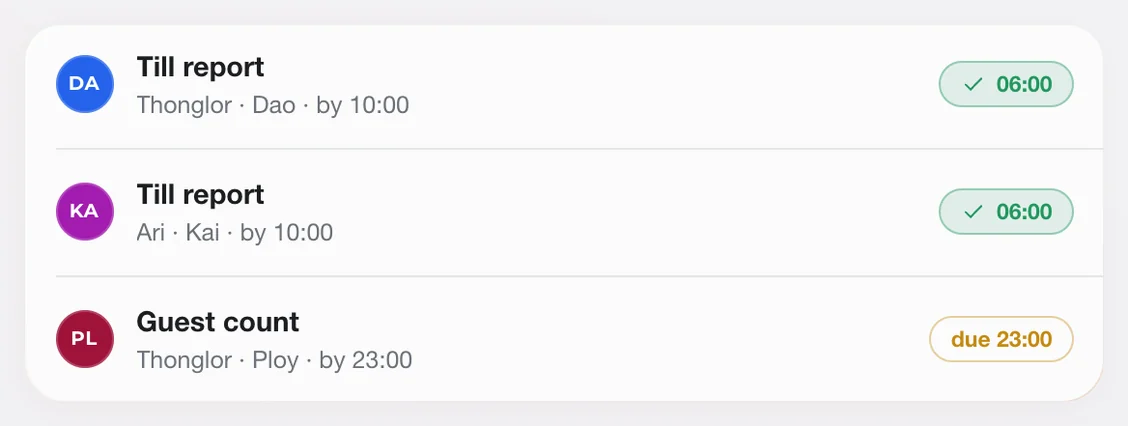
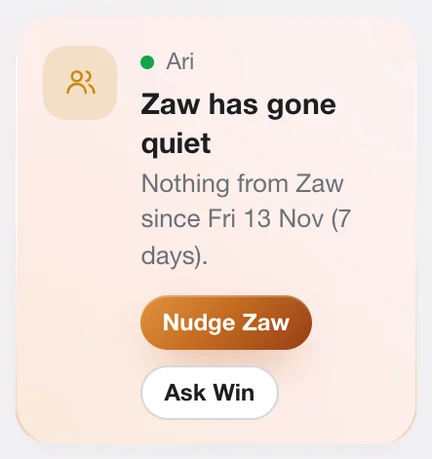
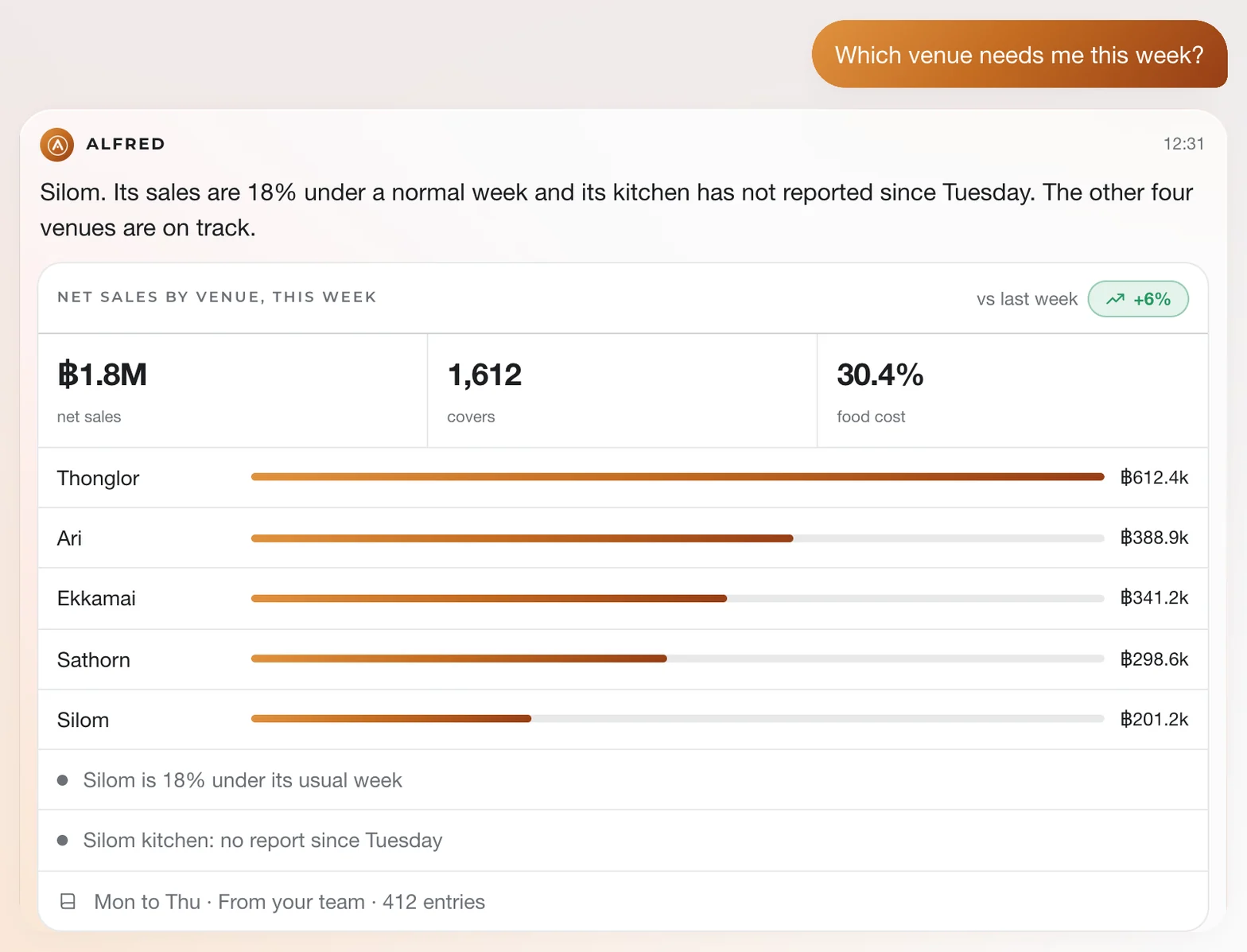
You cannot be in five places.
Every manager reports in their own way, if at all. You drive between sites to find out what happened, and still cannot tell a well run site from a lucky one.
Every site answers the same questions on the same clock. Alfred learns what normal looks like at each one and flags the day a site drifts.
Know which site needs you today, before you get in the car.
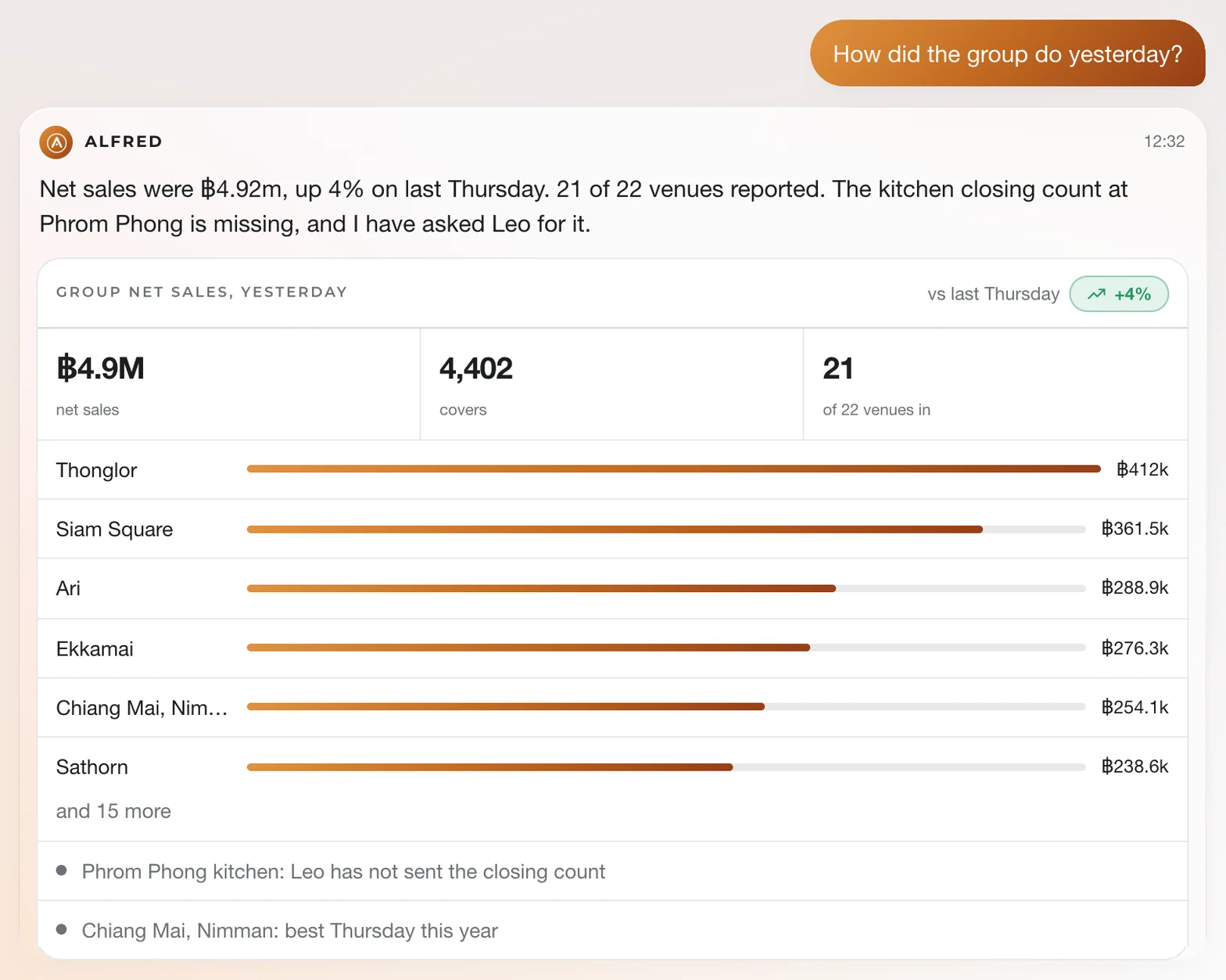
The report lands too late.
Area managers chase sites, someone retypes it all into a spreadsheet, and by the time the group figure arrives the week is over.
The group report builds itself every morning, from every venue, down to the person behind each number.
One standard across the group, without the memos.
What this costs restaurants today.
Restaurant operators were asked to name their hardest problem this year.
name keeping staff as their biggest problem, ahead of food costs at 29.7%. Every time someone leaves, what they knew leaves with them.
saw food costs rise in the first half of 2026. Nearly half of those saw a rise of 6% or more, mostly spotted after the fact.
per site, every week, spent counting stock by hand in one multi-site group. The counts were still out by 4 to 6% a month.
A cost problem found at month end has usually been running for thirty days.
Figures from the Restaurant365 2026 State of the Restaurant Industry mid-year report, more than 420 operators and nearly 10,000 locations, and from multi-site operator case data published by Supy.
What changes with Alfred.
Four things change, and none of them ask your team to do more work.
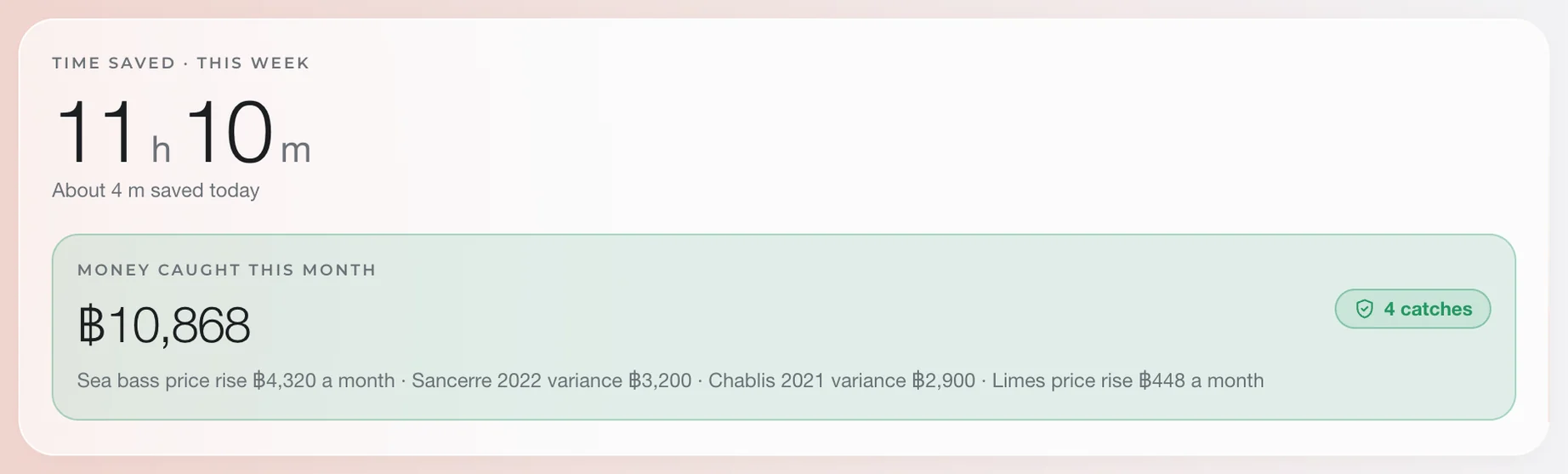
You stop collecting the information. You start making decisions with it.
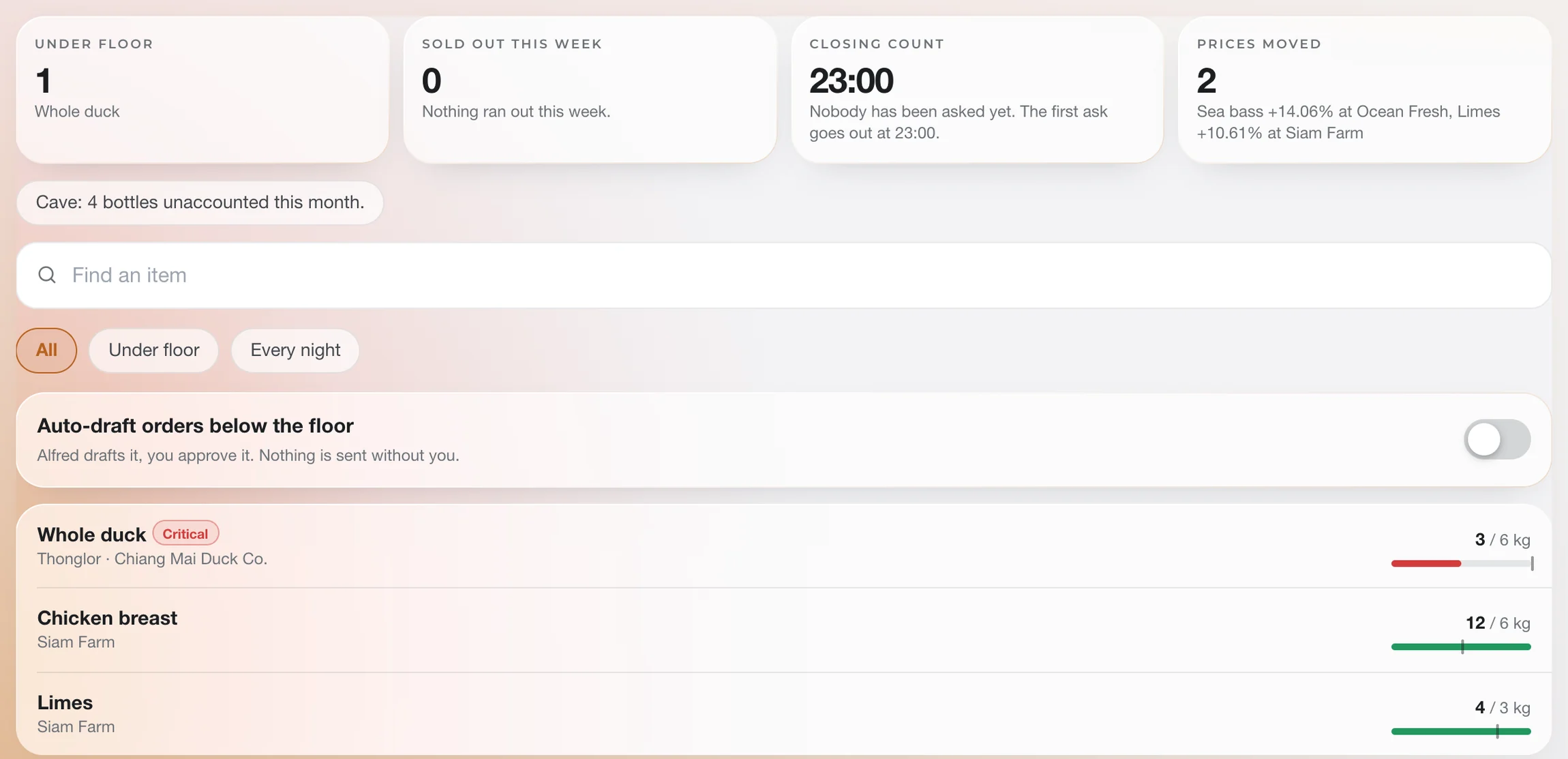
One app for the whole team. Each person sees their part.
Alfred Chat is Alfred's own messaging app, on the phone your team already has. It shows each person what their job needs, and nothing more. LINE and Telegram still work for anyone who prefers them.
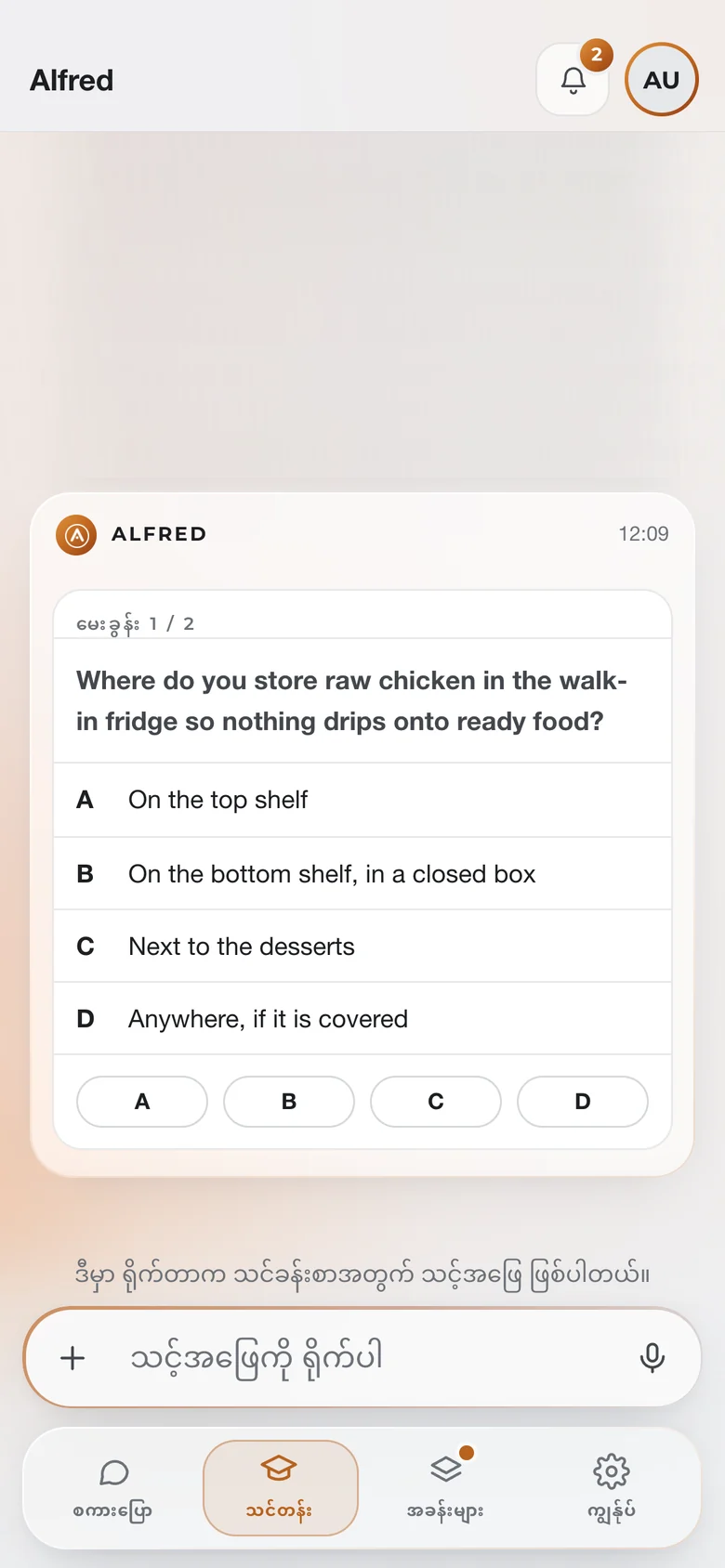
Staff
Report by voice, photo or message. Answer the day's training in a minute.
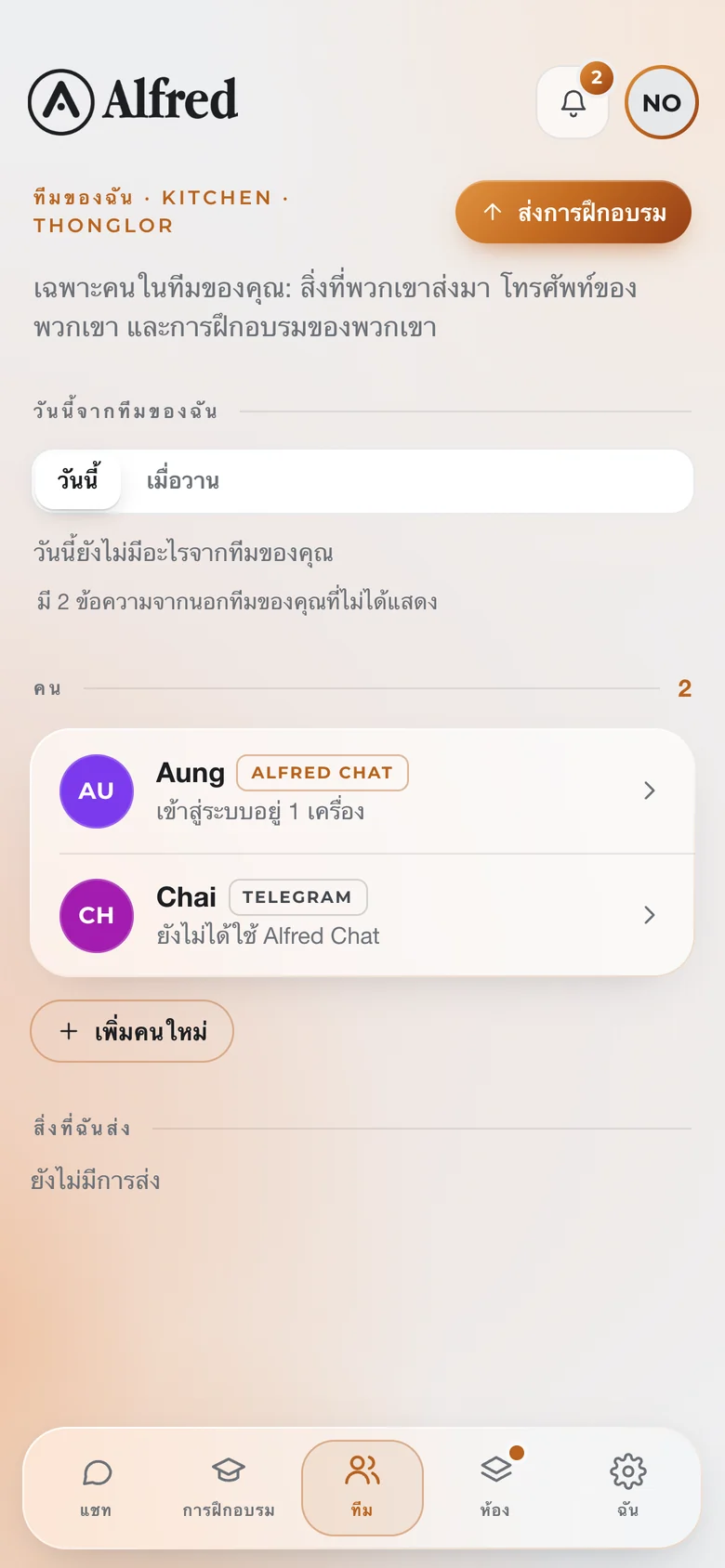
Managers
Their own people, what came in today, and training to send. Only their site.
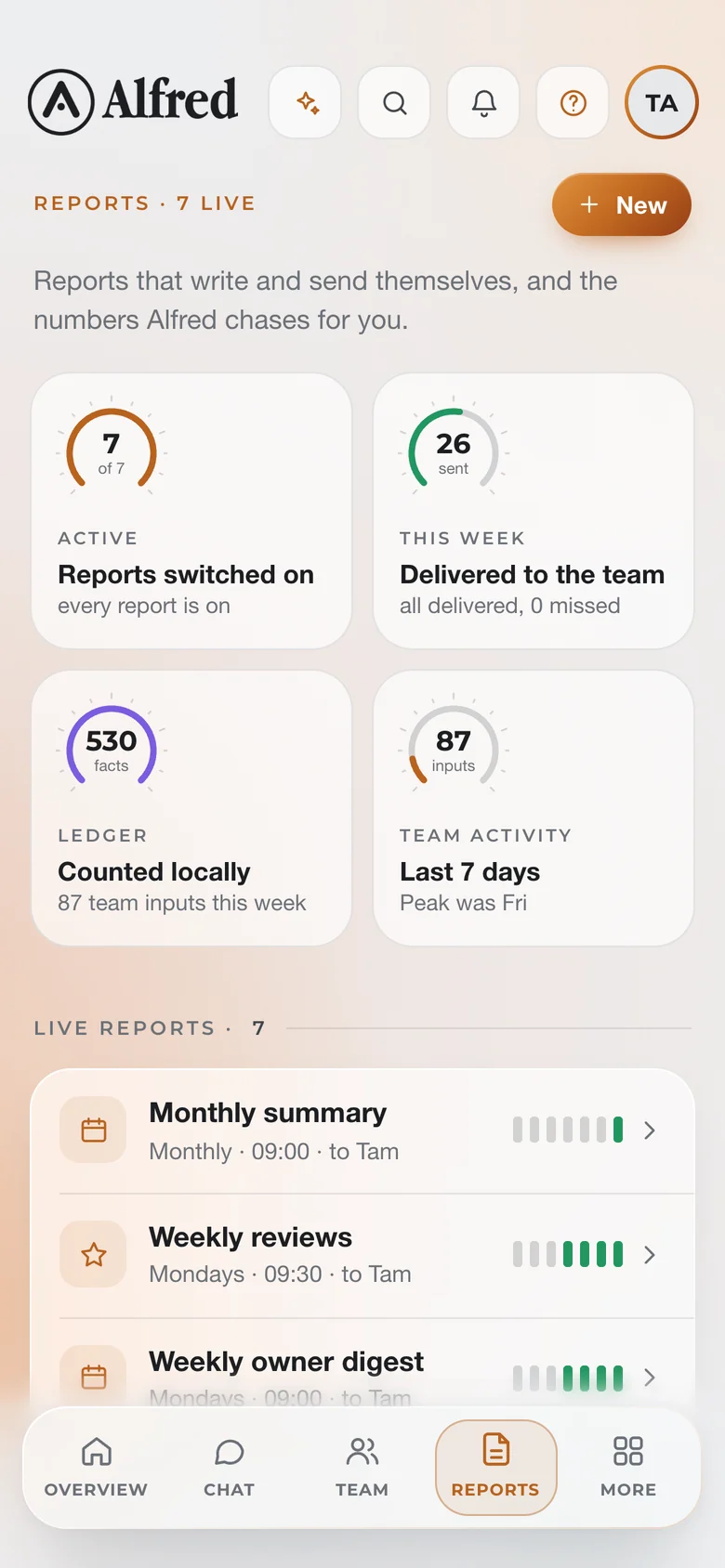
Owners and executives
The whole business, on the phone and on the desktop.
Aung reads Alfred in Burmese. Nok reads it in Thai. You read it in English.
Your numbers, your team and your training, in one place.
Alfred quizzes the team on your own notes, on a schedule, in their language. You see who knows what.


Use Case. A French bistro with a multilingual team.
Each staff member can write their reports in their own language, and Alfred automatically translates everything.
It allows us to start the day with a clear overview of what happened the previous day, without having to go through multiple conversations or chase staff members for information.
- Everyone reports in their own language.
- Everything is ready the following morning.
- Training twice a week, with clear SOPs for each position.
From Mamao's written use case, shared with their permission.
Easy to start. Safe to keep.
Nothing new to learn
Your team reports by voice, photo or message, in their own language. If they can send a message, they can use Alfred.
Running in three days
We set it up with you. Your first brief arrives on day three, and on day fourteen we count the difference with you.
Your numbers stay yours
Your records live on a server dedicated to your business. They are never used to train a model.
Asked, answered.
Anything else, ask us on the call.
What happens in the consultation?
Twenty minutes, remote. You tell us how your venues report today, we show you what your first week with Alfred would look like, and you decide if it fits. Nothing to prepare.
Does my team have to learn a new app?
No. Alfred Chat works like the messaging apps they already use, on the phone they already have, and LINE or Telegram work too. If they can send a message, they can use Alfred.
What if my team speaks different languages?
Each person writes and reads in their own language. Alfred translates, so you read everything in yours.
Where does our information actually live?
On a server dedicated to your business, not in a pool shared with other companies.
Does it replace my managers?
No. It removes the part of their job that is retyping and chasing, which is the part they like least.
See your first week with Alfred.
Twenty minutes, remote. Tell us how many venues you run and how they report today. We will show you what your first week with Alfred looks like.
Book a consultationOr write to info@alfred-ai.co